SOP: Shutdown Procedures
- Subtitle:
(MEG-KIT Shutdown procedures)
- Author:
Hadi Zaatiti
- DocID:
CTP_MEG_001
- Issue:
1.0
- po_number:
- Date:
March 2026
- approved_by:
NA
- date_approved:
March 2026
- Location:
A2-008, MEG Lab
This document describes the emergency shutdown procedures for the KIT-MEG system.
1. EMERGENCY CONTACTS
In the event of an emergency during shutdown, contact the following immediately:
NYU Abu Dhabi Security (24 hrs):, nyuad.campussafety247@nyu.edu +971 2 628 5555
MEG Research Scientist / Lab Responsible Person: Hadi Zaatiti, hz3752@nyu.edu, +971 56 275 4921
Vendor Emergency / Hotline:
KIT Corporation / Yokogawa Representative: Yoshiaki Adachi, adachi@ael.kanazawa-it.ac.jp
QD Helium: heliumrecovery@qd-europe.com, voigt@qd-europe.com, adler@qd-europe.com
Higher management NYUAD:
Director of CTP: Osama Abdullah, oa22@nyu.edu, +971 2 628 4990
Director of Laboratory Operations and Maintenance: Jake Edmondson, je53@nyu.edu, Office: +971 2 628 4756, Mobile: +971 56 194 5026
2. SCOPE
This Standard Operating Procedure documents the planned, controlled shutdown (discharge) of the KIT-MEG system in the event of a confirmed or anticipated prolonged liquid helium supply disruption.
It covers two execution Cases:
Case A – With Vendor Support: Controlled shutdown carried out with the equipment vendor present on-site or providing direct remote guidance.
Case B – Without Vendor Support: Controlled shutdown performed independently by trained CTP technical staff when vendor support is unavailable within the required timeframe.
This SOP does not cover emergency quench procedures. For unplanned or emergency quench events, refer to the system-specific emergency SOP.
3. EQUIPMENT DETAILS
System / Instrument Name: KIT-MEG System
Manufacturer: KIT / Yokogawa
Model / Serial Number: 256-Channel System with 208 axial gradiometer SQUIDS and 8 magnetometers
Field Strength: N/A
Nominal Helium Volume: 100 L liquid He-4 (Approximate working volume)
Location (Building / Room): A2-008, MEG Lab
Responsible CTP Platform: NeuroWaves Lab (Hadi Zaatiti)
Vendor Emergency Contact: KIT Corporation / Yokogawa Representative: Yoshiaki Adachi, adachi@ael.kanazawa-it.ac.jp
Internal Technical Contact: MEG Research Scientist / Lab Responsible Person: Hadi Zaatiti, hz3752@nyu.edu, +971 56 275 4921
Related Emergency SOP: CTP_BI_016
4. RESPONSIBILITIES
Director of CTP: Osama Abdullah, oa22@nyu.edu, +971 2 628 4990 Authorises the decision to initiate shutdown in writing. Notifies relevant stakeholders including users and institutional leadership as appropriate.
MEG Research Scientist / Lab Responsible Person: Hadi Zaatiti, hz3752@nyu.edu, +971 56 275 4921 Leads execution of the shutdown procedure. Coordinates with vendor. Records all steps and observations throughout.
Director of Laboratory Operations and Maintenance: Jake Edmondson, je53@nyu.edu, Office: +971 2 628 4756, Mobile: +971 56 194 5026 Confirms ventilation systems are operational prior to and during the procedure. Responds to any building-level safety or infrastructure issues.
NYU Abu Dhabi Security (24 hrs):, nyuad.campussafety247@nyu.edu +971 2 628 5555 Restricts access to the affected area. Stands by during the procedure if required.
KIT Corporation / Yokogawa Representative: Yoshiaki Adachi, adachi@ael.kanazawa-it.ac.jp Provides step-by-step guidance on-site or via phone/video call. Confirms safe completion of each stage and provides a written service record.
5. DECISION THRESHOLD: WHEN TO INITIATE CONTROLLED SHUTDOWN
The decision to initiate a controlled shutdown must be deliberate and formally authorised.
He supply disruption confirmed: Begin shutdown planning (He level <= 60% or vendor recommendation).
He level drops below operational minimum: Initiate shutdown (He level <= 30%).
Controlled shutdown not feasible — immediate safety risk: See emergency SOP for this system.
A controlled discharge from the SQUIDs prevents hardware damage. Recommissioning requires a complete He refill (at least 200 liters) — which may not be feasible during a supply disruption. This decision requires Director-level written authorisation and must not be taken unilaterally.
6. SAFETY SYSTEMS CHECKLIST
Complete this checklist before initiating shutdown. All applicable items must be verified and initialled by the responsible staff member. Do not proceed until all items are confirmed.
[ ] O2 deficiency monitor(s) confirmed operational and calibrated.
[ ] Ventilation in equipment room confirmed active.
[ ] Room access restricted — warning signage posted, adjacent labs notified.
[ ] PPE available: cryogenic gloves, safety glasses, lab coat.
[ ] Emergency contacts on standby (Section 1).
[ ] Written authorisation obtained from Director, CTP.
[ ] Lab record sheet prepared to log all steps, observations, and anomalies.
7. SHUTDOWN PROCEDURE
Shutting down the SQUID system is a straightforward process:
Turn off SQUID electronics: Power down the SQUID electronics racks.
Turn off Main PCs: Safely shut down all main workstation computers.
Turn off DAQ PCs: Safely shut down all data acquisition computers.
Allow Helium to Empty Naturally: You do not need to manually remove or vent liquid helium yourselves; the dewar will empty on its own through natural boil-off.
Turn off Dewar Heater: Once the dewar naturally reaches empty (or while running down to empty, since the local environment is dry and poses little risk of ice buildup), turn off the heater located on top of the dewar.
8. RESTART PROCEDURE
Restarting the SQUID system is a multi-day process requiring specific equipment and precise pressure control.
Phase 1: Vacuum Pumping
Dewar Vacuum: Evacuate the vacuum layer of the dewar by pumping. Duration: Normally 2 weeks (longer is better).
Transfer & Exhaust Tubes: Evacuate the vacuum pumping of the transfer and exhaust tubes attached to the Dewar. - Transfer tubes do not need to be removed from the Dewar. - Access ports for the pump hose are located outside the MSR. - Duration: Normally 2 hours to overnight (flexible). This can be done before or during Phase 1.
Phase 2: Initial Cooling (Day 1)
Requirement: At least 100L of liquid helium.
Safety Check: Unplug the cables for the liquid helium level meter and the heater (connectors are around the Dewar inside the MSR).
Preparation: Insert the transfer tube into the 100L helium cylinder along with the heater wand. Connect to the MEG transfer tube as usual.
Slow Transfer: Transfer must be much slower than a weekly refill (approx. 2–3 hours). This minimizes thermal stress on the room-temperature Dewar.
Pressure Control: - Set initial pressure to 2 kPa. - Maintain 2 kPa for the first hour. - Increase pressure from 2 kPa to 7 kPa over the second hour (e.g., +1 kPa every 10 minutes). - Continue transferring at 7 kPa until the cylinder is empty.
Completion: Replug the liquid helium level meter and heater cables. The level meter should indicate 20–30% capacity.
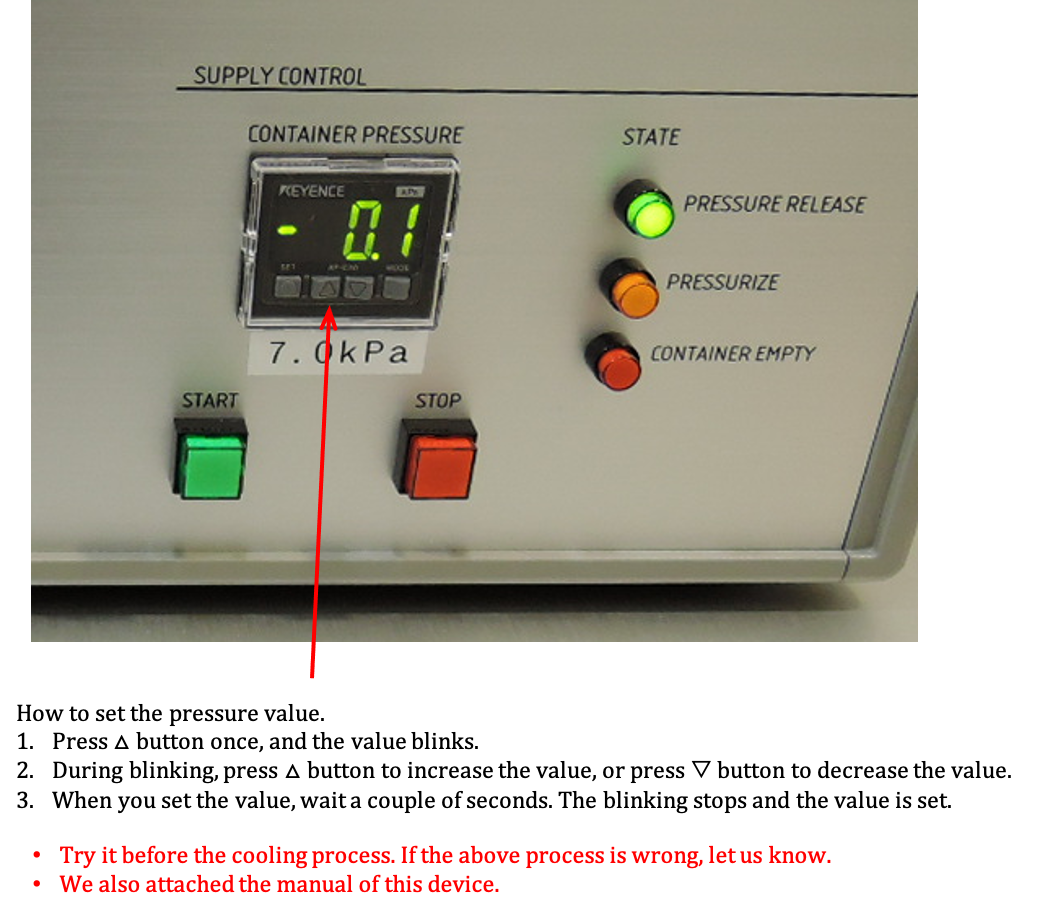
Figure: Pressure gauge setting (2 kPa) for the start of initial cooling.
Phase 3: Second Transfer (Day 2)
Requirement: At least 100L of liquid helium.
Morning Level Check: The helium level will likely have dropped below 10% overnight due to cooling the mass of the Dewar.
Standard Refill: Perform a second 100L transfer following the standard weekly refill procedure.
Target Level: Final level should reach approximately 60–70%.
Phase 4: Electronics & Sensor Check
Power On: Turn on the DC power supply for the SQUID electronics.
Auto-Tuning: Open the MEG160 software and perform auto-tuning as usual.
Functional Test: Click the [Sensor Check] button in the acquisition dialog. - A sinusoidal waveform should be visible on all SQUID channels. - A flat line indicates a damaged sensor or hardware issue.
Data Verification: Lock the sensors and record 30 seconds of data (Empty MSR: LPF 1kHz, HPF 0.03Hz, 5kHz sampling). Send this data to the vendor for confirmation.
Note: No full calibration is required if the Dewar remained closed and no electronics were replaced.
9. PASSIVE QUENCH: DECISION CRITERIA AND RESPONSE
A passive quench may occur if helium is exhausted before a controlled shutdown can be completed, or due to a system failure. If a passive quench is detected, treat it as an emergency:
Do NOT remain in the equipment room if a rapid quench is occurring.
Do NOT re-enter until O2 levels are confirmed safe (>= 20.9%).
Do NOT touch cryogenic exhaust lines or cold surfaces.
Activate all emergency contacts immediately.
10. WHAT TO EXPECT DURING CONTROLLED SHUTDOWN
Normal observations during controlled discharge:
Gradual decrease in system helium level readings.
Possible gentle venting noise from the cryogenic exhaust port.
No sudden pressure release, fog formation, or O2 alarm should occur under normal conditions.
Warning signs requiring immediate stop:
Sudden fog or white cloud formation inside or outside the equipment room.
Audible hissing or rapid gas release inconsistent with controlled venting.
O2 monitor alarm activation.
Any physical anomaly not described in vendor documentation.
11. POST-SHUTDOWN MANAGEMENT AND LONG-TERM STORAGE
Restrict access to the equipment room until the system has fully stabilised.
Verify and log O2 levels before any personnel enter the room.
Do not resume operation until: the system has been professionally inspected and recommissioned; and liquid helium supply has been restored and confirmed stable.
Keep equipment room locked with notice: ‘OUT OF SERVICE — DO NOT ENTER WITHOUT AUTHORISATION’.
Notify all current and prospective users of the system status and estimated downtime.
12. ESCALATION
If any part of the shutdown procedure cannot be completed safely or as planned, immediately notify:
Director, Core Technology Platforms: Reza Rowshan
CTP Operations Lead: Hadi Zaatiti (056 275 4921)
NYU Abu Dhabi Security: 971-2-628-5555
13. FIRST AID CONSIDERATIONS
Oxygen deficiency:
Remove affected person immediately from the area to fresh air.
Initiate first aid and call emergency services (999) if person is unresponsive.
Do not re-enter the area without confirmed safe O2 levels.
Cryogenic exposure (frostbite):
Do not rub the affected area.
Rinse with lukewarm (not hot) water.
Cover with a sterile dressing.
Seek immediate medical attention.
14. TRAINING
All staff executing or supervising this procedure must meet the following requirements:
Completed NYU Abu Dhabi Cryogenic Safety training.
Read and understood this SOP and the relevant emergency SOP for this system.
A minimum of two qualified staff members must be present and remain present throughout the execution of this procedure.
15. SIGNATURES
Approved by:
Signature:
Email:
Date:
Reviewed by: